
EMDR Intensives
When you understand what happened…
but your mind and body still respond as if it's happening now.
EMDR Intensives provide dedicated time to process distressing experiences so they become part of your story rather than something that continues to interrupt your life.
Is an EMDR Intensive Right for You?
You may benefit if...
Certain memories still feel overwhelming.
You avoid reminders of an experience.
You feel "stuck," even though you've talked about it.
You notice the same emotional reactions happening again and again.
Your logical mind understands something, but emotionally it still feels true.
You'd like focused time for trauma processing and integration.

What Is EMDR?
EMDR (Eye Movement Desensitization and Reprocessing) is an evidence-based therapy designed to help the brain process distressing experiences that have become "stuck."
Rather than erasing memories, EMDR helps reduce the emotional intensity associated with them while strengthening healthier, more adaptive beliefs.
Many people describe the memory as becoming something they remember, rather than something they continue to relive.
Why Do We Get Stuck?
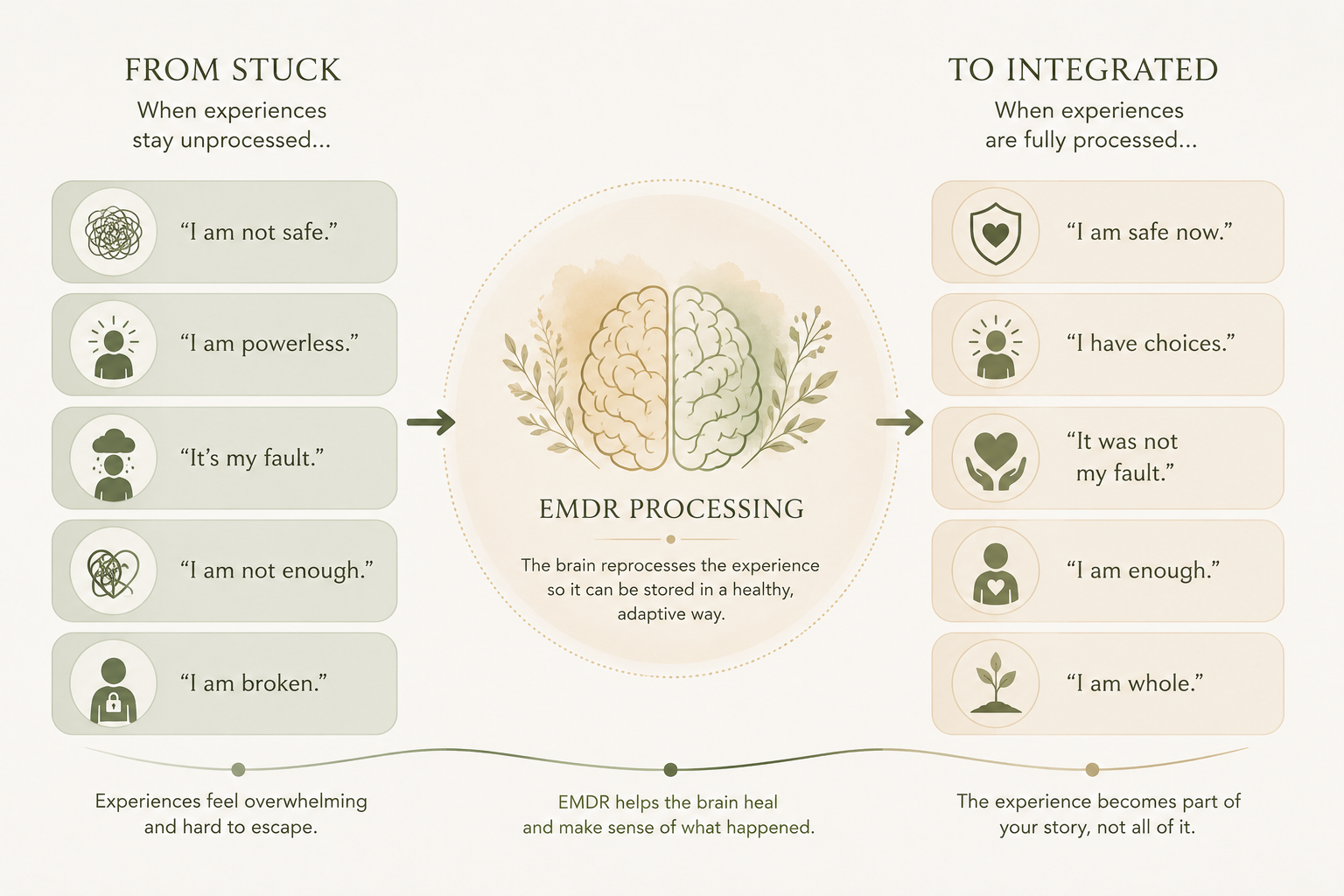
Sometimes our brains store distressing experiences differently than ordinary memories.
Instead of becoming integrated into our life story, the experience remains emotionally "unfinished."
That can lead to thoughts such as:
"I am not safe."
"I am powerless."
"I should have done something differently."
"I'm not enough."
"I'm broken."
Even when we know those thoughts aren't objectively true, they can continue to influence how we feel, respond, and relate to ourselves.
EMDR helps the brain process these experiences so they can be stored in a more adaptive way.
Together, We Might Work Toward...
Reducing emotional distress connected to specific memories
Strengthening healthier beliefs about yourself
Increasing emotional regulation
Decreasing avoidance
Feeling more present
Increasing confidence
Feeling safer in your body
Responding rather than reacting
Every Intensive Is Different
Common Experiences We Address
Childhood experiences
Medical trauma
Car accidents
Grief-related trauma
Assault
Workplace incidents
First responder experiences
Relationship trauma
Unexpected losses
Distressing memories that continue to feel present
Why an intensive, instead of individual session?
Trauma processing often benefits from having enough time to fully prepare, process, pause when needed, and integrate before returning to daily life.
Rather than feeling rushed by the clock, an intensive provides dedicated space to move thoughtfully through the work.
You May Notice Changes Like...
Feeling less activated when thinking about a difficult memory
Greater compassion toward yourself
A sense that the memory feels "farther away"
Feeling more present instead of pulled into the past
Increased confidence in your ability to cope
Greater emotional flexibility
More space to respond thoughtfully rather than react automatically
Feeling lighter, calmer, or more grounded
A growing sense that the experience is part of your story—not the whole story
What a Day Might Look Like
Every intensive is personalized, but a typical session may include:
Connection
Preparation
Processing
Break
Integration
Closure
Where We Meet
Office
Your home
Another meaningful location
EMDR Intensives FAQs
How long are intensives?
2, 3, or 4 hours, depending on goals and decided in collaboration with you.
Is this couples therapy?
No.
Is my trauma "bad enough" for EMDR?
This may be my favorite FAQ.
I might answer:
Many people assume EMDR is only for catastrophic events.
In reality, what matters most is how an experience continues to affect you today.
Sometimes a single event remains highly distressing.
Other times, repeated experiences over many years gradually shape the way we see ourselves, others, or the world.
If a memory continues to influence your thoughts, emotions, or reactions, it deserves compassionate attention—regardless of how it compares to someone else's experience.
Will I have to talk about every detail?
No.
You'll share enough for us to identify what we're working on, but EMDR does not require repeatedly telling your story in detail.
Will EMDR erase my memories?
No.
The goal isn't to forget.
The goal is to reduce the emotional intensity so the memory becomes part of your past rather than something that feels like it's still happening.
What if I cry?
You may. Strong emotions are a natural part of trauma processing.
We will move at a pace that feels manageable while supporting your nervous system throughout the experience.
How many memories can we process?
Every intensive is different.
Some people focus on one significant experience.
Others work with several connected memories.
We'll determine together what feels clinically appropriate.
Healing isn't about forgetting what happened.
It's about helping your mind and body recognize that what happened is no longer happening.
Together, we'll create space for that healing to begin.
Begin with a Conversation
Every Therapy Intensive begins with a consultation where we'll explore your goals, answer your questions, and determine together whether an intensive is the right fit for your needs.
Whether you're navigating grief, trauma, burnout, relationship patterns, or a major life transition, we'll create a plan that feels thoughtful, personalized, and supportive of your healing.